The short version
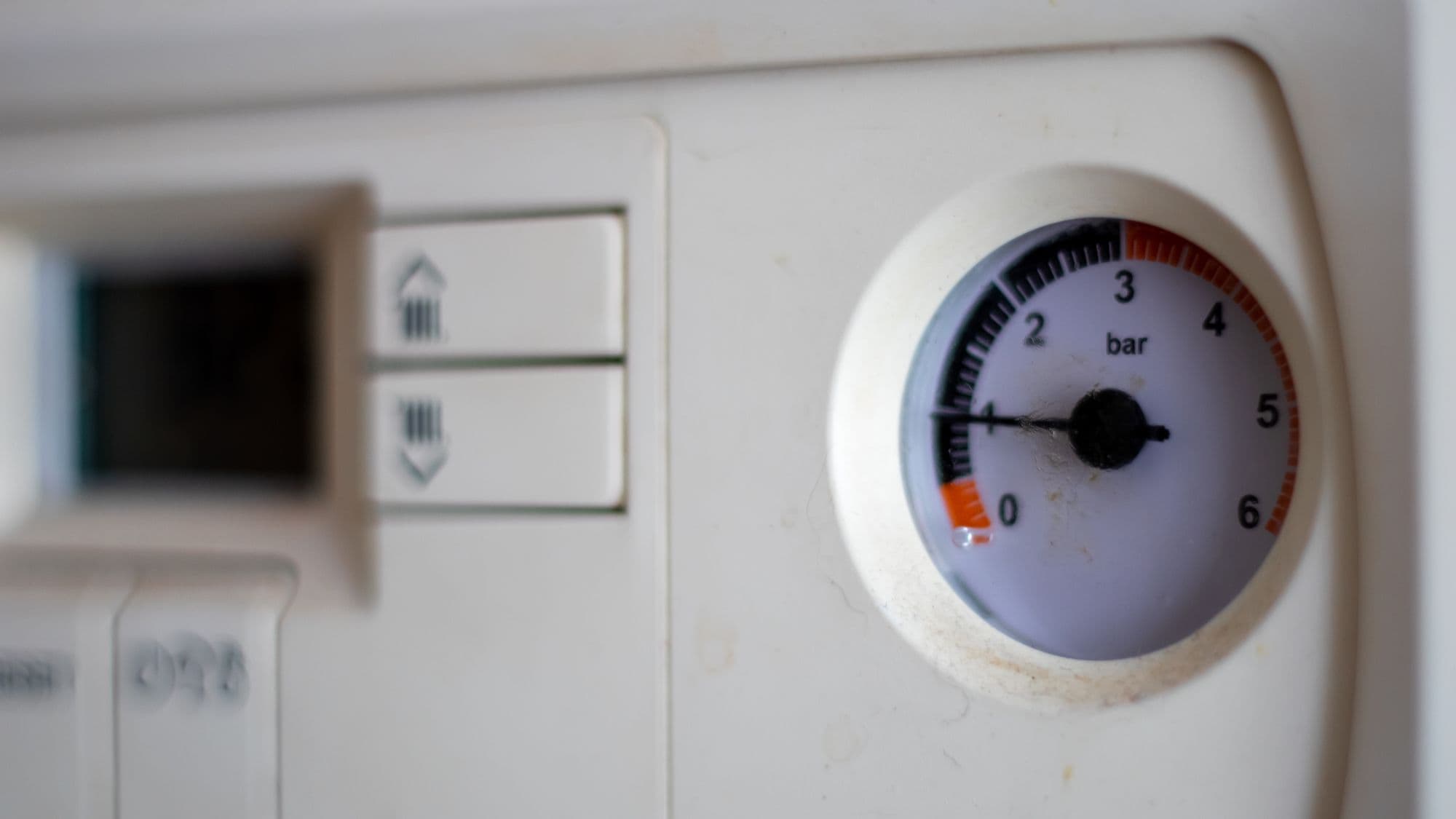
- Most sealed systems should read around 1 to 1.5 bar when cold. Check your boiler’s manual for its figure.
- You top up the pressure through the filling loop, never by opening the boiler casing.
- Some loops are an external braided hose with 2 valves; some combis have a built-in key or lever instead.
- If the pressure keeps dropping, there is a leak or a failing part. Call an engineer.
The short answer
With the boiler off and cool, open the filling loop slowly and let water into the system until the pressure gauge reads around 1 to 1.5 bar, then close it again. Turn the boiler back on and reset it if it shows a fault. Your boiler’s manual gives the exact figure and the steps for your model, so have it to hand.
This applies to sealed systems: combi boilers and system boilers with a pressure gauge on the front. Regular (heat only) boilers fed from a tank in the loft usually don’t need topping up this way.
Why the pressure drops in the first place
A sealed heating system is a closed loop of water, kept under a little pressure so the boiler can work. Some causes of a drop are normal and one-off: bleeding radiators lets out a bit of water along with the air, and a radiator or valve being changed means the system has been partly drained. In those cases, one top-up is all it needs.
A drop with no obvious reason, or one that keeps coming back, is different. Water is escaping from somewhere, and topping up only treats the symptom. Fresh water brought in repeatedly also brings fresh oxygen, which can add to corrosion inside the system over time.
Read the gauge first
The pressure gauge is on the front or underneath the boiler. It may be a dial with a needle, or a number on a digital display. Many dials have a green zone marking the normal range.
- Below 1 bar when cold: low. Many boilers stop working or show a fault code when it falls too far.
- Around 1 to 1.5 bar when cold: normal for many boilers. Check your manual.
- A little higher when the heating is on: normal. Water expands as it heats, so pressure rises when the system is hot.
- Well above the normal range, or water dripping from a pipe outside: too high. Don’t add more. See below.
Pressure keeps dropping? Tell us what it’s doingTwo minutes, no obligation, a Gas Safe engineer replies.
Start my quoteFind your filling loop
The filling loop connects the cold mains to your heating system, so you can let water in. There are 2 common types:
- External filling loop. A silver braided hose under the boiler, joining 2 pipes, with a valve at one or both ends. The valves are often a small lever or a slot you turn with a flat screwdriver.
- Built-in filling loop. Some combis have one on the underside of the boiler, worked by a lever, tap or a removable key that slots in underneath. Your manual shows where it is and how it works.
If you have a built-in loop, follow the manual exactly. It is designed to be used from outside the casing. Don’t remove any covers that need tools, and never open the boiler itself.
Step by step: topping up the pressure
- 1Turn the boiler off and let the system cool. The pressure reading you’re aiming for is the cold one.
- 2Find the filling loop. On an external loop, check the braided hose is connected securely at both ends.
- 3Open the valve slowly. If there are 2, open one, then slowly open the other. You’ll hear water flowing into the system.
- 4Watch the gauge closely. When it reaches around 1 to 1.5 bar, or the figure in your manual, close the valves.
- 5If your manual says to disconnect an external hose after use, do so, with a towel ready for a few drips.
- 6Turn the boiler back on. If it shows a fault, press reset once.
- 7Check the gauge again once the heating has been running, and again over the next few days.
If the pressure keeps dropping
A sealed system shouldn’t keep losing pressure. Bleeding radiators lowers it a little, and you’d expect to top up afterwards. But if you’re topping it up every few days or every week, something is wrong. The usual causes are:
- A leak. Look for drips or damp on radiator valves, under the boiler and on visible pipework. Small leaks can evaporate before you notice them, and some hide under floors.
- The pressure relief valve. A safety valve that lets water out if pressure gets too high. If it’s worn or has opened, it can keep passing water. Look for drips from the pipe that runs from the boiler through the outside wall.
- The expansion vessel. A tank inside or next to the boiler that absorbs the water’s expansion as it heats. If it loses its charge, pressure swings high when hot, the relief valve can open, and the pressure drops when cold.
All 3 need an engineer, because the relief valve and the expansion vessel are parts of the boiler. Book a boiler repair and mention how often you’ve had to top up. If the boiler has stopped and you have no heating or hot water, see emergency boiler repair.
Staying safe
Topping up through the filling loop is one of the few boiler jobs that is safe to do yourself. Everything else on a boiler, including anything behind the casing, is work for a Gas Safe engineer. Keep water away from electrics, and if water is leaking from inside the boiler, turn it off and catch the drip rather than trying to find the source.